# DUMAS H3 Continuum Tiled 3.9.4.post1 — V3.9 fork
## DUMAS H3 Sequence Prompt Builder
`DUMAS H3 Sequence Prompt Builder` creates the single multiline `STRING`
prompt expected by the Continuum sampler. Its editor provides one tab per
clip and editable local time slots inside each clip. Clip-local times are
flattened to absolute timeline positions when the node executes, so it can be
connected directly to `Sequence Prompt` with `Prompt Format = Timeline` (or
`Auto`).
All clip tabs use the single `Default chunk duration` control. There is no
per-clip duration because Continuum multi-clip projects are intentionally
uniform; resizing a shot boundary updates its timestamp in the visible prompt
editor immediately.
The editor follows the CSGlide shot-timeline model: one prompt editor per
clip, coloured shot bands, and draggable boundary sliders between shots. Use
the `@ Add shot` button, or type `@` at the start of a new line in the prompt
editor, to create the following timed section quickly.
The node keeps the shared visual directive, soundscape, and non-diegetic music
outside the clip tabs. The editor state is stored in a serializable JSON
widget, making saved workflows portable even when the optional browser panel
is unavailable.
Example output:
```text
Preserve the same character and environment.
[0-4s]
The character walks forward and looks toward the light.
[4-8s]
Continue seamlessly as the character raises one hand.
overall_soundscape: Quiet room tone and footsteps.
non_diegetic_music: Low cinematic pulse.
```
## Dumas per-clip tiled latent upscale
This fork adds **H3 Continuum Tiled Latent Upscale (Per Clip)**. Connect the
`video_latents`, `assembly_plan`, and `refine_context` outputs from the
Continuum sampler, plus its `model` and `CLIP`, and connect the native
`MMH3 Latent Upscale` and `MMH3 Spatial Split Params` nodes.
Each physical clip is sent through `MMH3UltimateUpscale` independently, with
its own upscale sampler, scheduler, steps, denoise, CFG and seed controls.
The result remains a LATENT list, so clips do not get concatenated into one
larger VRAM allocation before the tiled pass. Temporal length is validated and
cannot silently change.
The node consumes `refine_context` directly and internally performs the same
context-to-conditioning adaptation as **H3 Continuum Conditioning Bridge V3.5**.
The separate `conditioning` input is optional for advanced legacy graphs; it is
not needed in the normal Continuum wiring.
The recommended production wiring is now the **H3 Continuum Second Pass V3.5**
node with `tiled_upscale = true`. That node receives the main sampler's video
and audio latent lists plus its `refine_context` and `assembly_plan`, rebuilds a
complete AV latent for each physical group, and runs the native tiled upscale
one group at a time. It returns the upscaled video latent list while preserving
the first-pass audio latent list. Connect the latent-upscale and spatial-split
parameter nodes to its optional tiled inputs; its sampler, scheduler, steps,
denoise, CFG and noise seed are independent from the ordinary Second Pass
settings.
The node is an adapter around ComfyUI's native MiniMax H3 tiled-upscale
implementation; it does not include model weights or vendor the upstream
implementation. Install this repository as a normal custom-node folder and
restart ComfyUI after updating it.
**Latest package: 3.9.4.** Use the fixed-version GitHub downloads below. Registry publication is verified separately.
| Version | Release | Custom-node ZIP | SHA-256 checksum |
| --- | --- | --- | --- |
| 3.9.4 | [Release](https://github.com/ukr8b3g-cmyk/ComfyUI-H3-Continuum/releases/tag/v3.9.4) | [ZIP](https://github.com/ukr8b3g-cmyk/ComfyUI-H3-Continuum/releases/download/v3.9.4/ComfyUI-H3-Continuum-v3.9.4.zip) | [SHA256SUMS.txt](https://github.com/ukr8b3g-cmyk/ComfyUI-H3-Continuum/releases/download/v3.9.4/SHA256SUMS.txt) |
| 3.9.3 | [Release](https://github.com/ukr8b3g-cmyk/ComfyUI-H3-Continuum/releases/tag/v3.9.3) | [ZIP](https://github.com/ukr8b3g-cmyk/ComfyUI-H3-Continuum/releases/download/v3.9.3/ComfyUI-H3-Continuum-v3.9.3.zip) | [SHA256SUMS.txt](https://github.com/ukr8b3g-cmyk/ComfyUI-H3-Continuum/releases/download/v3.9.3/SHA256SUMS.txt) |
| 3.9.2 | [Release](https://github.com/ukr8b3g-cmyk/ComfyUI-H3-Continuum/releases/tag/v3.9.2) | [ZIP](https://github.com/ukr8b3g-cmyk/ComfyUI-H3-Continuum/releases/download/v3.9.2/ComfyUI-H3-Continuum-v3.9.2.zip) | [SHA256SUMS.txt](https://github.com/ukr8b3g-cmyk/ComfyUI-H3-Continuum/releases/download/v3.9.2/SHA256SUMS.txt) |
The original [3.9.2 GitHub source archive](https://github.com/ukr8b3g-cmyk/ComfyUI-H3-Continuum/archive/refs/tags/v3.9.2.zip) remains available from its unchanged tag. This custom-node package ZIP is distinct from the official workflow ZIPs.
## 3.9.4 — Registry packaging repair (2026-10-14)
Include the declared Review restoration guide and exclude repository-only prompt-authoring files from the Registry ZIP. The publishing workflow now builds the actual package and checks its exact file set, CRC and every Registry Manifest hash before uploading. Runtime behavior, twelve public node IDs, workflows and saved Runs/Takes are unchanged. GitHub Releases 3.9.3 and 3.9.2 remain available.
## 3.9.3 — choose temporary storage (2026-10-13)
Choose where Continuum writes its temporary decoded frames and Finalize buffer. Open **Settings → H3Continuum → Storage → Manage temporary storage**. Enter an absolute folder on the **ComfyUI server**, or choose a server storage candidate, then validate and save. Leave it blank to keep the existing locations. No workflow changes are required; continue using the V3.9 nodes and your 3.9.1 / 3.9.2 workflows.
- The selected folder applies to **both Finalize and Decode Cache Helper**. It contains a dedicated `h3-continuum-scratch` directory. Saved Runs/Takes and finished videos keep their existing locations.
- The panel shows current and previous locations, temporary file sizes, free space, and files in use or eligible for deletion. **Delete unused temporary files** protects live outputs, Tensor views, active processes and files whose ownership cannot be verified. Deleting a cache can require decoding and writing it again.
- Save or clean only when the running and pending queues are empty. New files use the new location; existing outputs remain valid at their old locations. A missing selected drive does not silently redirect writes to your original SSD. Shared storage controls are read-only in multi-user mode.
- Mode selection stays in the existing nodes: **Finalize: Auto / RAM / Disk-backed**; **Decode Cache Helper: Auto / RAM / Off**. Auto keeps its conservative 4 GiB final-IMAGE threshold and RAM reserve. Manual RAM now checks available memory before allocation; manual Disk-backed checks free space. These checks cannot guarantee against OOM, changing disk usage or a drive disconnect during execution. No new VRAM storage mode is added.
**Moving storage changes where writes occur, not their total volume.** With only one physical drive, moving to another folder or partition on that drive does not divert its writes. A separate SSD is usually the faster alternative; an HDD can be used but may slow decoding, assembly and saving. If sufficient CPU RAM is available, RAM modes can avoid these scratch writes, but memory pressure can cause paging or OOM. Turning Decode Cache Off does not turn off Finalize's Disk-backed buffer. File-size displays are logical sizes, not physical disk allocation or cumulative SSD writes. Local filesystems are supported; network shares are outside this feature's supported scope.
Update the custom node package, restart ComfyUI to load the backend, and hard-refresh the browser. Later changes to this storage setting take effect without a restart. Blank settings retain the ComfyUI temp directory for Finalize and `H3_DECODE_CACHE_TEMP_DIR` (or OS temp) for Decode Cache. A selected folder takes precedence over that cache environment variable.
The storage changes preserve frame dtype, video/audio assembly and generation identity. Validation and remaining platform limits are recorded in [PACKAGE_VALIDATION.txt](PACKAGE_VALIDATION.txt). The implemented settings screenshot appears at the top of this README. GitHub Release and Registry publication status are listed above; neither follows automatically from a source update.
If the panel reports HTTP 404, inspect the ComfyUI startup log. An old process can keep the chosen address/port occupied, so the updated process fails to start while its new JavaScript is already visible. Stop the obsolete instance or choose another port, then start the updated backend. **Refresh** retrieves storage status; it does not restart ComfyUI. Failed reads now show the HTTP result and keep mutations disabled until status is available.
## 3.9.2 — Issue #30 frontend hotfix (2026-10-13)
This hotfix reduces unnecessary Review and Reference Images UI work:
- Skip upstream Review settings snapshots when no comparison baseline exists.
- Notify connected Samplers once per Reference selection, preserving immediate native values and the original widget callback.
- Skip Reference node resizing when its target dimensions already match its actual dimensions.
Review monitoring with a baseline and fresh Take/Queue checks remain in place. Sampling, saved Runs/Takes, public node IDs and official workflow bytes are unchanged. Keep using the V3.9 nodes.
The frontend repair passed **1,703 CPU/JavaScript regression tests, 2 skipped**, with **2 explicit expected failures** for the independent Reference Plan Inspector bug after repeated Sampler configuration. Offline Core registration/planning and isolated Chromium checks passed. Real ComfyUI browser checks for this package are recorded in [PACKAGE_VALIDATION.txt](PACKAGE_VALIDATION.txt); mobile freeze resolution is unconfirmed. Reference table rebuilding and Review snapshots with a baseline remain. No new GPU generation is part of this hotfix's validation.
After updating, **hard-refresh the browser (Ctrl+F5)** to load the JavaScript. Restart ComfyUI normally to update the displayed package version. A 3.9.1 Run/Take does not require migration for this UI hotfix. Versioned downloads are listed in [GitHub Releases](https://github.com/ukr8b3g-cmyk/ComfyUI-H3-Continuum/releases); Registry publication is separate.
## 3.9.1 — what changed (2026-10-04)
This patch fixes Second Pass conditioning, Take reuse and Review audio:
- **Second Pass:** preserve audio-only/mixed keyframes and inherit the verified conditioning and Reference assignments of the actual Review output, including a single middle chunk.
- **Take reuse:** include sampler closures and MODEL CFG/wrappers in compatibility checks to prevent reuse under different generation settings.
- **Review Driving Audio:** cut the source PCM once at the physical group's natural time, with the same start position for Exact ON/OFF.
- **Audio resampling:** prefer ComfyUI Core's standard API, with the legacy fallback for older Core versions. The Reference Encode Cache limitation for direct VAE weight changes is documented below.
**Updating from 3.9.0:** restart ComfyUI and refresh the browser after updating. Existing v5 Takes and history remain readable and are not deleted, but cannot be reused as prefixes for new v6 generation. Start a new Full Video or choose **Start again from Chunk 1**. Public node IDs, widget order and official workflows remain unchanged; keep using the **V3.9** nodes.
The repaired code passed **1,696 CPU tests / 1 skipped**, targeted Review Second Pass GPU checks and an integrated generation/reuse check. Browser acceptance remains pending. Optional latent-upscale doubled outlines are tracked separately in [Issue #27](https://github.com/ukr8b3g-cmyk/ComfyUI-H3-Continuum/issues/27); they are not a required gate for these fixes. This is a main-source update, not a new GitHub Release or Registry publication.
## 3.9.1 repair details
Second Pass preserves audio-only keyframes and adapts only the video component of mixed keyframes. Review Driving Audio uses the retained natural frame range of the physical decode group, measured before projection. Exact ON/OFF share that PCM origin. Completely empty Review intervals receive silence for the selected video duration; partially short audio stays short with Exact OFF.
New generation uses Sampling Contract v6 and Graph Contract v4, including sampler code/closures and MODEL CFG/wrapper settings. Saved v5 Takes, raw tensors and provenance remain readable, but cannot be reused in v6 generation. Start a new Full Video or use Review's **Start again from Chunk 1** to create a new revision. Old Takes remain intact. Unobservable external settings still allow fresh generation with reuse disabled; incompatible explicit Take/Retry requests are not replaced with a different Take.
Reference/Driving resampling prefers Core's standard API and uses legacy TorchAudio only when that API is absent. Preserved output PCM keeps its original waveform and sample rate.
**Reference Encode Cache limitation:** direct weight mutation inside the same VAE object is not detected automatically. Call `v3.ref_encode_cache.clear_ref_encode_cache()` afterwards or reload into a new VAE object. Unchanged VAE/input pairs continue to hit the cache. Decode Cache Helper reset affects a separate cache and does not clear Reference Encode Cache.
This repair stays within V3.9: public node IDs, socket/widget order, official workflows, Run Storage v3 and State/Session formats are retained. LoRA Plan is not included. CPU checks and browser/GPU acceptance are separate.
V3.9 also projects captured conditioning onto the actual Review output groups before Second Pass. A partial prefix or a single middle chunk can inherit its own conditioning and Reference assignments when the context validates. Full-sequence completion and saved Takes are unchanged; missing or mismatched context keeps the diagnostic prompt-only fallback.
The repaired runtime passed **1696 CPU tests, 1 skipped**, and three targeted GPU cases at **512×512 / 24 fps**: a two-group partial prefix, Chunk 2 alone, and complete three-group reuse. All groups inherited verified conditioning; saved FLAC matched the corresponding source PCM exactly and existing Takes/raw files were preserved. This validates the targeted repair. Browser acceptance remains pending; optional latent-upscale double outlines are a separate investigation in Issue #27. Historical V3.8 releases and tags remain available unchanged.
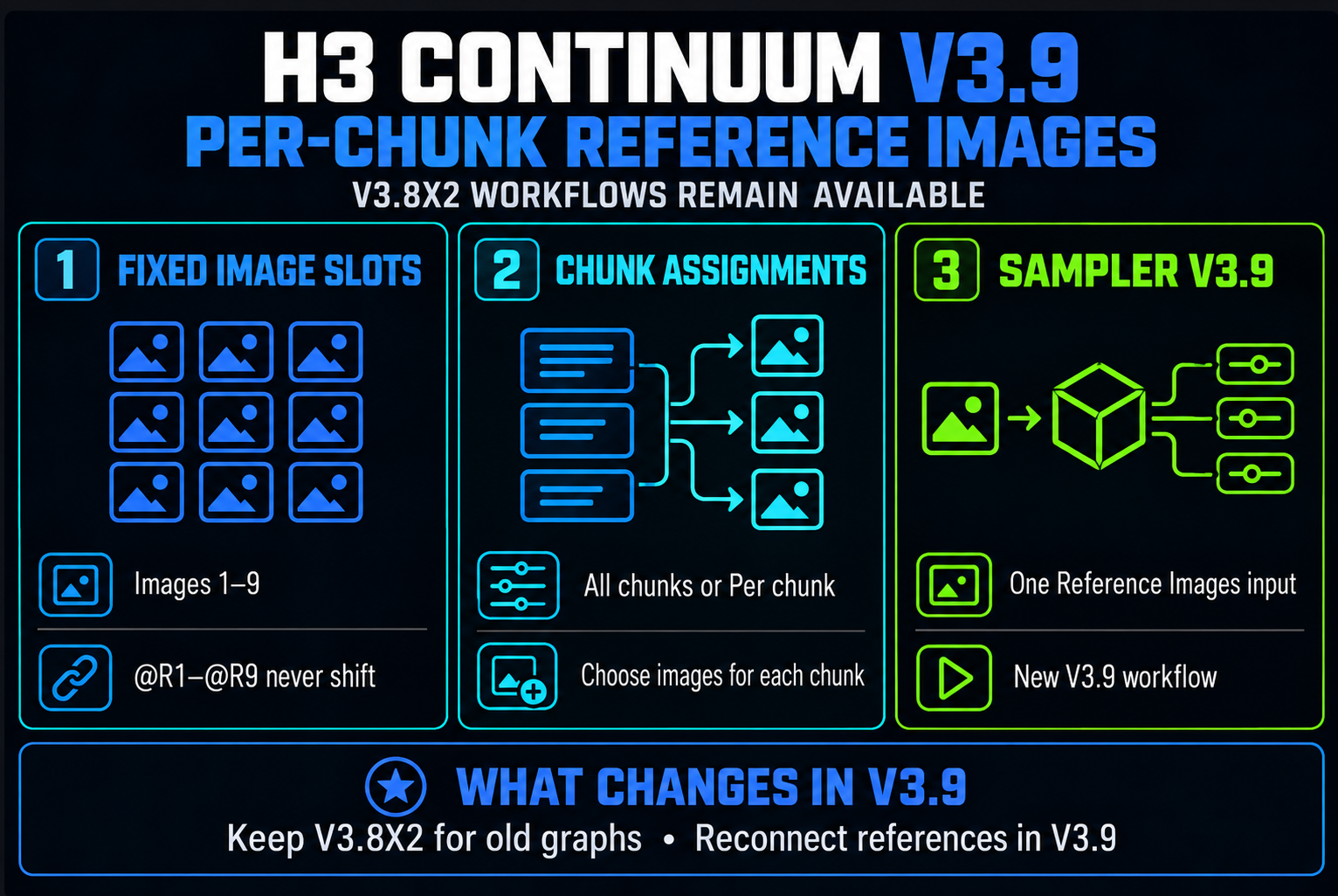
*V3.9 is current on `main`: fixed Image 1–9 slots, per-chunk Reference selection, and one Reference Images connection to the V3.9 Sampler.*
## Getting started video
[H3 Continuum V3.9 — Getting Started: Chunks, Prompts & Reference Images](https://youtu.be/AKJxBXaiG6Q) (12:26)
Learn basic First Image setup, chunk settings, Review/Take retries, Timeline prompting, and Reference Images. Includes English narration and subtitles, seven timestamped chapters, version-labeled UI stills, and actual generated examples.
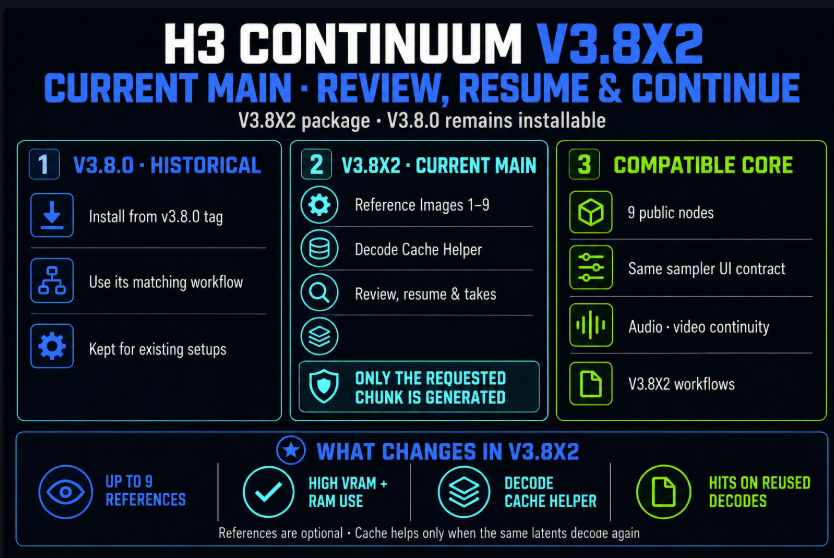
*This V3.8X2 card is retained for comparison. Its “CURRENT MAIN” label describes the time it was made; V3.9 is current now. The V3.8 Sampler and V3.8X2 workflow remain available, but their Reference wiring is not automatically converted to V3.9.*
## External INT Width/Height fix on main (2026-10-01)
Fixed the visible Width/Height input binding in both V3.8 and V3.9. External INT connections now stay aligned with their displayed controls through workflow save/reload and tab switching. Connected controls are read-only; their displayed numbers are saved Manual reserve values, not a prediction of the upstream node's runtime output. Disconnecting restores local editing.
To set exact dimensions from Core **Int** nodes, choose **Size Source = Manual** and connect the Width and Height INT inputs. **First Image** still uses the image and Resolution setting; connected dimensions do not override it or automatically change Size Source. If no active First Image is available, the existing Manual fallback applies. Dimension validation and backend input order/defaults are unchanged.
Validation: **1569 CPU tests passed, 1 skipped**, including 22/22 new frontend regression cases and 60/60 existing Review cases; Chrome save/reload and five tab round trips for both versions. One V3.9 GPU smoke run with external INT values produced exactly **480×640, 96 frames at 24 fps, with 4-second audio** in **107.3 s** (20 sampling steps); the entire saved video decoded successfully. This is a short single-condition check, not long-form or all-model acceptance. Sampling, Run Storage, the earlier Review/cache repairs, official workflow JSONs/ZIPs and historical Releases are unchanged.
Update Continuum from `main`, then **hard-refresh the browser (Ctrl+F5)** to load the new JavaScript. This fix alone does not require a ComfyUI backend restart; restart normally if the update also brings Python changes or new node definitions. This remains a main-source fix, not a new Release or Registry package.
## V3.9 performance fix on main (2026-10-01)
V3.9 could repeat unnecessary prompt-conditioning preparation when **Prompt Format = Fixed** and **no Reference Images are selected**. This repair reuses the existing bounded conditioning cache when its inputs are unchanged. First Image is supported; List/Timeline prompts, selected Reference Images, Reference Audio, Timeline Video and terminal-pair groups keep their existing paths. This is not the Decode Cache Helper and does not skip Sampling.
In the tested `2 × 5 s`, 480×640 First Image workflow, group preparation fell from about **10.76 s to 0.013 s**. In the post-fix same-session comparison (three measured runs per version, after warm-up), median total time was **273.58 s for V3.8 vs 273.78 s for V3.9**; the ranges overlapped. The earlier roughly 6% gap was no longer observed under these conditions. This does **not** establish a speed fix for every workflow, model or GPU, or a GPU-kernel speedup.
Update Continuum from `main` and **fully restart ComfyUI** to load the Python changes. Validation: **1558 CPU tests passed, 1 skipped; all 8 GPU generation runs succeeded** on ComfyUI 0.38.0 / RTX 5060 Ti 16 GB. Seeds, chunk/frame contracts, Run Storage, V3.8X2/V3.9 official workflows and ZIPs, and historical Releases are unchanged. This is a main-branch fix, not a new Release or Registry package.
## Review restoration fix on main (2026-10-01)
Switching to another workflow and back could hide Review actions even though saved Takes still existed. This frontend repair waits for workflow restoration before reading history and ignores stale results from previous graphs. Real generation-setting changes still disable Review/Take application; restoring the original settings re-enables the actions.
Update the custom node from `main`, then refresh the browser to load the new JavaScript. Validation: 60/60 frontend regression cases, 108 focused CPU tests, five Chrome tab round trips, and a Chrome Base Seed edit/restore test; saved Take metadata stayed unchanged. Sampling, Run Storage contracts, V3.8X2/V3.9 workflow files and historical Releases are unchanged. GPU continuation was not tested for this repair. [Details and verification limits](docs/REVIEW_RESTORATION_REPAIR.md).
## Start here: V3.9 and the retained V3.8X2 workflow
The ComfyUI **Templates → ComfyUI-H3-Continuum** gallery offers two separate entries: the user-selected [V3.9 workflow](examples/workflows/MiniMax_H3_Continuum_V39.json) and [V3.8X2 workflow](examples/workflows/MiniMax_H3_Continuum_V38X2.json). The [V3.8X2 workflow ZIP](examples/workflows/MiniMax_H3_Continuum_V38X2.zip) contains **both unchanged JSON workflows** for one-download setup; the [V3.9 ZIP](examples/workflows/MiniMax_H3_Continuum_V39.zip) contains only V3.9. These are workflow archives, not custom-node installers. The V3.8 Sampler remains available, so existing V3.8X2 workflows still load. V3.9 does not automatically convert their Reference connections or saved Runs/Takes: preserve the old workflow and open the dedicated V3.9 graph for new work.
The selected V3.9 template has 32 nodes. Image loaders 1–6 are wired to the new helper and bypassed by default; slots 7–9 remain available but require the user to add and connect their own image loaders. Choose actual files and enable only the desired images. The saved size controls are **First Image + Draft — 0.30 MP**, and the separate First Image loader is enabled; select your own First Image file before Queue. The saved 480×640 Width/Height values apply only in Manual mode. `Reference Image Size` is `Match Output`; it resizes conditioning after source-image load, not the source files themselves. For a clear per-chunk Reference test, turn First Image and Last Image off, switch to Manual, and use Reference Images alone. First/Last additionally constrain the video; Last Image may merge the final two logical chunks into one physical group, which requires the same effective Reference set in both. A subject may remain visible in later chunks through video continuity even after its Reference is no longer assigned.
In the helper, `All chunks` uses connected images throughout; `Per chunk` provides an image-by-chunk table. The template starts in `Per chunk` with all assignments off: after enabling a loader, tick the chunks that should use it. Slot numbers never shift: Image 1 is `@R1` and Image 9 is `@R9`, even when intervening slots are empty. In Sequence Prompt, describe the action for each chunk and use `@R` tags only for active References; their actual `` numbers are resolved per group. Unused tags warn without stopping generation. Start with short chunks and pre-resized images: source images may consume RAM before the Sampler's Reference Image Size setting applies.
V3.9.3 is the current source version on `main`. Download versioned source from [GitHub Releases](https://github.com/ukr8b3g-cmyk/ComfyUI-H3-Continuum/releases); ComfyUI Registry publication is separate. Historical Releases and tags remain available. Configured 1024×1024 Reference-only GPU/API runs succeeded, but the unchanged default template and browser save/reload remain separate acceptance gates. For a reproducible older environment, use the matching historical Release/tag and workflow; the retained V3.8 Sampler on current `main` specifically supports V3.8X2 workflows.
`pyproject.toml` declares ComfyUI `>=0.32.0`; earlier real-generation/GPU validation used ComfyUI `0.34.2`, and the scoped Fixed cache comparison above used `0.38.0`. The minimum declaration does not establish V3.9 runtime acceptance on 0.32.0. The previous Windows CPU run is `1696 passed / 1 skipped / 0 failed`; the earlier separate Linux rerun report records `1534 passed / 3 skipped / 0 failed` and does not include the new cache or external INT tests. Neither replaces browser save/reload or GPU acceptance for the unchanged official template.
## V3.9 Reference Images
### Reference Images node: choose the image for each chunk
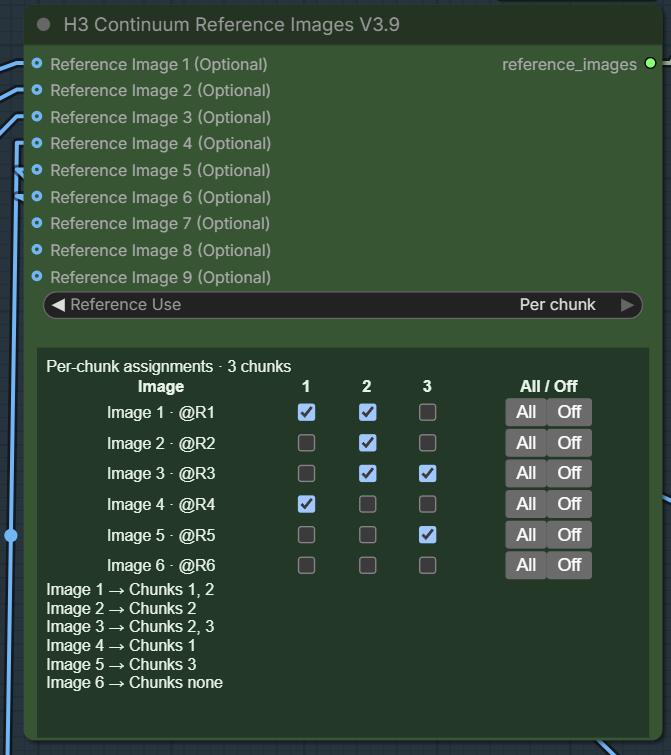
*Example UI, not the downloadable workflow's default assignments.* Image 1–9 are fixed slots: Image 1 is always `@R1`, even when other slots are empty. With `Reference Use = Per chunk`, tick the image/chunk intersections you want; each row's `All` / `Off` buttons select or clear that image across chunks. In this screenshot, Image 1 is assigned to Chunks 1 and 2, while other images have different assignments. The official V3.9 workflow starts with its image loaders bypassed and every assignment unchecked; choose real image files, enable their loaders, then tick the intended chunks.
### Sampler V3.9: connect the helper once
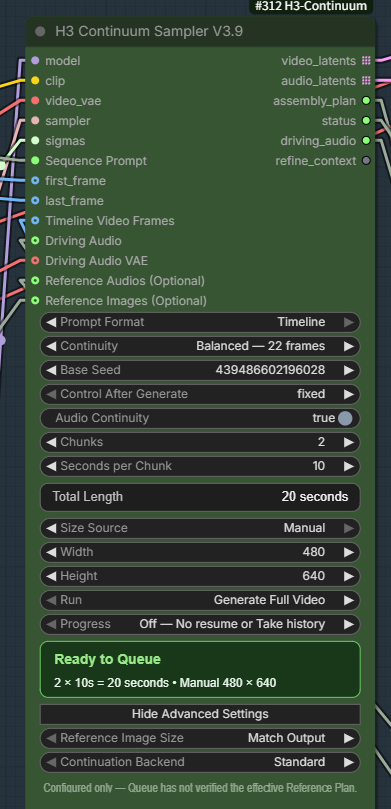
Connect the helper's green `reference_images` output to the Sampler's single `Reference Images (Optional)` input. The V3.8X2 workflow uses its own V3.8 Sampler and older Reference sockets; opening it does not convert those connections to V3.9. This screenshot shows a **Manual 480×640 example**, not the official V3.9 workflow's saved **First Image + Draft 0.30 MP** setting. `Reference Image Size = Match Output` controls Reference conditioning size after image loading; it does not pre-resize source files or set output resolution.
V3.9 now connects all nine fixed Reference Images through one **H3 Continuum Reference Images V3.9** node. Its in-node table selects All chunks or specific chunks. The V3.9 Sampler has one typed Reference Images connection and keeps Sequence Prompt, First/Last, Review and the rest of its generation controls. Use `@R1` for Image 1; the backend converts active tags to the group's actual ``. Both modes use the same group-routing engine.
Prompt parsing never blocks generation. If an explicit Timeline cannot be parsed, the original text falls back to Fixed with diagnostic `H3C-P100`. An uncovered Timeline chunk reuses the previous prompt and reports `H3C-P101`. Select the image for each chunk in the Reference Images node; `@R1`–`@R9` in Sequence Prompt refer to those fixed image numbers.
For the supplied `2 × 10 s` workflow, put each time header on its own line and describe only that chunk's action. For example, after enabling the matching image loaders and checking their chunk assignments:
```text
[0-10s]
@R1 walks forward through a quiet hallway. The camera follows smoothly.
[10-20s]
@R2 enters from the right. The camera turns to follow @R2.
```
Use the actual subjects and actions from your images; this is a syntax example, not a saved prompt in the downloadable workflow. Do not place prompt text on the same line as `[0-10s]`: that is not a Timeline header. A Reference can still influence a chunk without an explicit `@R` mention when its checkbox is enabled.
The [official V3.9 workflow](examples/workflows/MiniMax_H3_Continuum_V39.json) is the latest user-supplied JSON, copied without editing; its [single-workflow ZIP](examples/workflows/MiniMax_H3_Continuum_V39.zip) is also available. It preserves the full V38X2 model/LoRA, Decode Cache, Finalize and Save chain. Six image loaders are prewired (initially bypassed); to use Image 7–9, add `H3 Continuum Load Image` nodes and connect them to the matching helper slots. The Sequence Prompt input remains connected but is intentionally blank: write your own prompt before Queue. The saved graph uses `Timeline`, two 10-second chunks, `Full Run` (displayed as Generate Full Video), First Image + Draft 0.30 MP size selection, and a separate Project ID. The earlier [Reference Inline migration fixture](examples/workflows/MiniMax_H3_Continuum_V39_Reference_Inline.json) remains available unchanged. See the [step-by-step Reference Images guide](docs/V39_REFERENCE_INLINE.md). Replace local media and model filenames as needed before Queue; enabling an image requires choosing a real file. Seven to nine active references can be particularly memory-intensive: start with fewer, smaller source images. A full ComfyUI backend restart and browser hard-refresh are required before the new node definitions appear. Browser save/reload and GPU acceptance of this unchanged default graph are still pending; a GitHub Release does not imply these gates or a Registry package have been completed.
**Compatibility:** Existing V3.8X2 workflows still use the V3.8 Sampler and old Reference Images 4–9 helper. V3.9 needs its new helper and connection. Open the new V3.9 workflow instead of only changing the Sampler type in an old graph: older V3.9 prototype workflows with direct 1–3 connections and Sampler-side routing widgets need manual rewiring, and their saved widget positions may differ. Accepted V3.8 Runs/Takes are not automatically migrated. Keep a copy of the previous workflow and use a new Run Name for V3.9.
Earlier browser checks covered the previous V3.9 controls. The new helper has GPU/API execution evidence; its browser save/reload and the unchanged default template's full acceptance are still open. CPU/JS and manifest results are separate; no V3.9 Release/Registry publication is implied.
**Version boundary:** V3.8X2 package 3.8.3 and V3.9.0 are separate workflows. This update does not create a V3.8X2 or V3.9 GitHub Release, tag, maintenance branch, or Registry version; it does not remove any older Release. The existing [`v3.8.0` tag](https://github.com/ukr8b3g-cmyk/ComfyUI-H3-Continuum/tree/v3.8.0) remains the reproducible V3.8.0 baseline.
## Loader persistence repair on main (2026-09-21, after 3.8.3)
The current paired V3.8X2 workflows now use **Core Load Audio** and **Core Load Video -> H3 Continuum Video Adapter**. The adapter has Force Rate (default 24) and IMAGE/AUDIO outputs, but **no Enable switch or file selector**. Core owns video selection/upload/save; the established duration-preserving frame selection is reused and audio is passed unchanged. To disable Video Guide, bypass the adapter or the whole video-input group; do not bypass only Load Video while leaving its required-input adapter active.
**H3 Continuum Load Image remains**, including Enable Image. Its mode observer now delegates to inherited Core setters (Issue #23), and no longer replaces the widget collection while drawing or saving. Enable is appended after Core's widgets; Core handles the filename and native Bypass persistence. The older Audio/Video node IDs remain loadable as deprecated compatibility nodes, not as the recommended new-workflow loaders. The V3.8X2 baseline registered ten node IDs including these two legacy nodes; V3.9 adds the V3.9 Sampler and Reference Images helper as separate IDs, for twelve total. V3.8 Sampler inputs, generation parameters, Decode Cache, Finalize and existing latent/storage contracts are unchanged.
After updating, restart ComfyUI and reload/refresh the frontend. A workflow that already omitted its filename or saved an incorrect mode cannot recover those missing values: reselect the intended file and Bypass state, then save once. Existing user workflows and saved Takes are not automatically rewritten. Changing upstream node types can legitimately create a new Run Storage revision; preserve the original workflow when resuming accepted runs.
Validation details and limits: [Loader repair record](docs/LOADER_PERSISTENCE_REPAIR.md). CPU/store-model regression tests are not a substitute for the pending Windows Core 0.36.0 / frontend 1.53.6 browser tab-switch acceptance. No Release/tag or Registry publication is implied by this main-branch repair. Older loader screenshots below describe the retained legacy nodes.
## Timeline Video — Experimental on main
The existing video IMAGE input is now displayed as **`Timeline Video Frames`** and has one appended optional control, **`Video Reference Mode`**. Existing workflows and API calls that do not contain the new setting keep the old behavior through the default **`Repeat Reference`** mode.
- **`Repeat Reference`** keeps the legacy Video Guide contract: each physical generation group receives the same bounded prefix from the source. It does not loop or stretch a short source.
- **`Follow Timeline`** uses the 24 fps source interval corresponding to each physical output group. Continuation-prefix frames are not consumed twice. If the source ends, the remaining groups continue without video reference; a final usable partial interval may receive only H3's short frame-grid padding.
This setting is independent of `Prompt Format = Timeline`. It does not add a new socket or loader, does not use the source video's audio automatically, and does not provide frame-perfect motion copying. The complete decoded IMAGE batch is still held in system memory, so this feature is not a long-input RAM optimization.
Use the existing connection:
```text
Core Load Video -> H3 Continuum Video Adapter -> Timeline Video Frames
```
The two comparison workflows are intentionally separate from the unchanged official V3.8X2 workflows:
- [Follow Timeline JSON](examples/workflows/MiniMax_H3_Continuum_V38X2_Timeline_Experimental_Follow.json) | [ZIP](examples/workflows/MiniMax_H3_Continuum_V38X2_Timeline_Experimental_Follow.zip)
- [Repeat Reference JSON](examples/workflows/MiniMax_H3_Continuum_V38X2_Timeline_Experimental_Repeat.json) | [ZIP](examples/workflows/MiniMax_H3_Continuum_V38X2_Timeline_Experimental_Repeat.zip)
Local acceptance passed with full CPU `1424 passed / 1 skipped / 0 failed`, browser save/reload, and Follow/Repeat `2 x 5 s` GPU runs at 704x416, 24 fps, 240 frames, and 10-second 32 kHz stereo audio. Follow changed to the later source interval for Chunk 2 while Repeat retained the shared prefix; both completed without OOM, NaN, allocation failure, or crash. Peak observed VRAM was about 15.6–15.7 GiB on the tested RTX 5060 Ti 16 GB system, so 16 GB headroom was small. This is a functional mode-separation result, not a universal speed or subjective-quality guarantee. See [Timeline Video Experimental](docs/TIMELINE_VIDEO_EXPERIMENTAL.md).
> **V3.8X2** is the product and workflow label for package `3.8.3`. It keeps the V3.8 production sampler and adds optional Reference Images 4–9 plus the built-in Decode Cache Helper. The older V3.8.0 package remains available from tag [`v3.8.0`](https://github.com/ukr8b3g-cmyk/ComfyUI-H3-Continuum/tree/v3.8.0).
## Official V3.8X2 workflows
- **Standard name:** [JSON](examples/workflows/MiniMax_H3_Continuum_V38X2.json) | [ZIP](examples/workflows/MiniMax_H3_Continuum_V38X2.zip)
- **Helper-explicit name:** [JSON](examples/workflows/MiniMax_H3_Continuum_V38X2+Decode_Cache_Helper.json) | [ZIP](examples/workflows/MiniMax_H3_Continuum_V38X2+Decode_Cache_Helper.zip)
The two V3.8X2 JSON names contain the **same official graph**; they are distribution aliases, not different configurations. Both include the built-in Decode Cache Helper with its saved `Auto / RAM 256MB / Disk 8GB / reset_token 0` settings and the nine-reference helper connection. The standard V3.8X2 ZIP now also contains the separate V3.9 JSON, while the helper-explicit ZIP contains only its correspondingly named V3.8X2 JSON. Older V3.8X workflows remain available for existing projects.
## Nine Reference Images: memory warning
Reference Images 1–3 connect directly to the Sampler. Optional images 4–9 connect through `H3 Continuum Reference Images` and then to `Reference Images (Optional)`. Using all nine is a high-resource configuration, not the normal minimum requirement.
The acceptance run completed on an **RTX 5060 Ti 16 GB / 64 GB system** only after the nine source references were kept near **0.30 MP each**. With `512 × 608` output, `3 × 5 seconds`, Spectrum Off, LoRA Off, Sage Attention, and Balanced 22-frame continuity, Sampling used about **15.0–15.5 GiB of 16,311 MiB VRAM**. There was little 16 GB headroom.
When using many references, especially all nine, resize copies of the source images to about 0.30 MP before loading or connecting them. The Sampler still performs its normal conditioning resize, but smaller source files reduce input and preprocessing pressure. Larger references, larger output sizes, extra wrappers, or concurrent GPU work may require a higher-spec GPU and more system RAM. Nine references are optional and are not guaranteed to improve quality over three.
## Built-in Decode Cache Helper
### Important: this is not an unconditional new-generation speedup
**Manual cache clear:** normally no action is needed. Press the Helper's "キャッシュをクリア" (Clear cache) button to discard that Helper's cache on the next Queue and run native Decode again. It does not delete immediately or queue automatically. The internal `reset_token` remains serialized for workflow/API compatibility and increments once per click (wrapping to 0 at the INT limit). Creating, loading, or cloning a node does not change it. Without JavaScript, or in API workflows, change `reset_token` through the traditional numeric input.
**The Helper saves time only when unchanged latents are decoded again. It does not accelerate Sampling.** A first MISS runs native Decode and stores the result; hashing and storage can make that run slower. Generating different latents with a new random seed each time normally produces MISS, so this feature should not be expected to speed up that usage.
Concrete reuse scenarios:
- **Continue by adding chunks:** when existing chunk latents are retained and decoded again for output, cached existing chunks can HIT; newly generated chunks initially MISS.
- **Fix / partial regeneration:** unchanged chunk latents can HIT when submitted again; regenerated chunks whose latent contents changed MISS.
- **Complete / Resume output:** decoding retained latents again without resampling can benefit. Merely playing an existing video file is not a cache use case.
- **Retry from Decode onward, or change Finalize/output settings:** reuse applies when the same latents and decode-related metadata reach the Helper and Decode runs again.
- **Regenerate with a fixed seed:** reuse requires identical resulting latent contents. The same seed alone does not guarantee HIT.
The action names themselves do not enable reuse. **Each Video/Audio entry must match in latent contents, shape, dtype, decode-related metadata, and VAE identity, and its cache entry must still exist in that Helper.** If ComfyUI reuses an existing output without executing Decode, there is no additional Decode saving attributable to this Helper. Connect the Helper and select `Auto` or `RAM`. In its report, `hit` means reuse, `miss` means native Decode, and `off` / `bypass` mean no cache reuse.
Cache reuse is process-local and does not survive Python restarts. Eviction and VAE identity changes can also cause MISS. Changing mode, RAM/Disk budgets, or `reset_token` clears this implementation's Helper cache. Keeping `reset_token = 0` does not reset it on every Queue.
V3.8X2 ships `H3DecodeCacheHelper` inside this Continuum package. It remains a separate public node under `MiniMax H3/Continuum/Helpers`; no second custom-node addon is needed. The original nine IDs remain registered for compatibility; the loader migration adds H3ContinuumVideoAdapter. Sampler, Finalize, Assembly Plan, Core Decode, and saved Sampler widget/socket contracts are unchanged.
Connect Sampler `video_latents` and `audio_latents` plus their native Video/Audio VAE inputs to the Helper, then connect Helper `images` and `audio` to Finalize. Keep the Sampler `assembly_plan` directly connected to Finalize. The [official V3.8X2 workflow](examples/workflows/MiniMax_H3_Continuum_V38X2.json) preserves its saved graph and settings. It contains no Core VAE Decode nodes, so returning to Core direct Decode requires adding those two Core nodes and reconnecting Finalize, or loading a prior Core-direct V3.8X workflow. Do not simply remove the Helper and expect automatic rewiring.
`Auto` caches full physical Video decodes on private process-local disk and small Audio decodes in bounded RAM. `Off` delegates native Decode and clears the Helper cache. Cache failure falls back to native Decode; native Decode, OOM and queue interruption are not retried. Files are not reused across Python restarts. Keep only one provider of the `H3DecodeCacheHelper` node ID: the previous standalone addon must be disabled or removed during the migration, after a verified built-in installation.
At 736×416 (0.306MP), 3×5 seconds, Euler/simple 6 steps, Turbo FL2V v1.2, a warm backend and three Video HITs, one measured configuration produced a **mechanistic estimate of about 47 seconds / 24.5% less Full Run Total**. One direct A/B pair observed 50.887 seconds / 26.46%, and two Complete/Resume re-decode pairs averaged 46.309 seconds / 79.826% less Total. These are narrow observations, not repeated universal averages or an unconditional 20%+ speed promise. The first MISS can be slower, new Sampling is not accelerated, and a changed latent or VAE identity produces a MISS.
**Historical V3.8X workflow: [JSON](examples/workflows/MiniMax_H3_Continuum_V38x.json) | [ZIP](examples/workflows/MiniMax_H3_Continuum_V38x.zip)** — [Published releases](https://github.com/ukr8b3g-cmyk/ComfyUI-H3-Continuum/releases)
✅ V3.8X on `main` includes the September 8, 2026 Review hotfix: Review Each Chunk continuation, stale `Regenerate From` state, completed-sequence extension, and Render History queue handling are repaired. Update with `git pull --ff-only origin main` (or ComfyUI Manager **Update**), restart ComfyUI, and hard-refresh the browser if the old UI remains. Existing saved Takes are preserved. Issue #13 remains a separate open long-continuation quality issue and is not part of this hotfix.
H3 Continuum is a Production Sampler for generating, reviewing, partially regenerating, and resuming long-form MiniMax H3 video without restarting the entire work. V3.8 has two product layers: **Main / Production** and **Advanced**.
## Install or update first
For a new Git installation:
```bash
cd ComfyUI/custom_nodes
git clone https://github.com/ukr8b3g-cmyk/ComfyUI-H3-Continuum.git
```
For an existing Git checkout:
```bash
cd ComfyUI/custom_nodes/ComfyUI-H3-Continuum
git pull --ff-only origin main
```
Restart ComfyUI after cloning or pulling. If ComfyUI Manager installed the node, use its **Update** action instead of mixing Manager updates with a second Git checkout.
To install the historical V3.8.0 package into a separate checkout instead:
```bash
cd ComfyUI/custom_nodes
git clone --branch v3.8.0 --single-branch https://github.com/ukr8b3g-cmyk/ComfyUI-H3-Continuum.git ComfyUI-H3-Continuum-v3.8.0
```
Use only one Continuum checkout at a time. ComfyUI Manager **Update** tracks `main`; it does not select historical tags.
Download the current V3.8X2 workflow: [JSON](examples/workflows/MiniMax_H3_Continuum_V38X2.json) or [combined V3.8X2/V3.9 ZIP](examples/workflows/MiniMax_H3_Continuum_V38X2.zip). The V3.8X2 JSON is one Spectrum-capable graph, also usable with [LightX2V Turbo](https://github.com/ModelTC/Minimax-H3-Turbo); both Spectrum and all Turbo LoRA entries are saved disabled. Install its external Spectrum, rgthree, and KJNodes nodes before opening it. ComfyUI-Easy-Use is not required. See [Spectrum and Turbo setup](#turbo-lora-and-spectrum-in-supplied-workflows) below.
## Prompt and skill downloads
- [V3.9 Reference Images prompt skill](write-h3-v39-reference-prompts/SKILL.md) | [ZIP](write-h3-v39-reference-prompts.zip) — for fixed `@R1`–`@R9` image slots and per-chunk assignments. Use it with the V3.9 Reference Images node; it is separate from the general Continuum prompt skill below.
- [LLM system prompt ZIP](H3-Continuum-LLM-System-Prompt-v1.zip) — system instructions and reference material for Continuum prompt authoring.
- [Continuum prompt skill ZIP](H3-Continuum-Skill-v1.zip) — general chunk-aware prompt authoring for Codex and other compatible agents.
- [Continuum Dance Director skill ZIP](minimax-h3-continuum-dance-director.zip) — long-form choreography prompts for one primary dancer, with body and camera continuity across chunks.
These are optional prompt-authoring resources, not ComfyUI custom nodes. Extract each ZIP and follow its included instructions. They do not change the sampler or guarantee generated motion or image quality.
## You can ask an AI to read this manual
This README is intentionally detailed. You do not have to memorize it. Give its GitHub URL or this file to a web-enabled AI, describe your target video, GPU/VRAM, available First Image/audio, and whether you want to review every chunk. Ask it to use the **exact V3.8 labels** below.
Example request:
```text
Read the current ComfyUI-H3-Continuum V3.8 README. I have a 16 GB GPU and want
to create a 30-second I2VA video, reviewing every chunk. Tell me exactly which
Continuum inputs and controls to use, what must stay fixed between Queue runs,
and what output length I should expect after each action. Do not use older V3.7 UI.
```
AI products, plans, and repository-reading behavior change frequently. If a URL is not read correctly, paste or upload this README instead. Do not send private workflows, local paths, tokens, or credentials to a public AI service. The README and the UI remain the source of truth; an AI summary can still be wrong.
## V3.8 supported surface
The V3.8X2 baseline registers ten node IDs, including two deprecated loader compatibility IDs; V3.9 adds a separate Sampler and Reference Images helper. Current official workflows use Core Load Audio and Core Load Video plus the Video Adapter.
- **H3 Continuum Sampler V3.8** — the Main sampler
- **H3 Continuum Finalize** — decoded Video/Audio assembly with optional seam handling
- **H3 Continuum Load Image**
- **H3 Continuum Load Audio** (legacy compatibility; new workflows use Core Load Audio)
- **H3 Continuum Load Video** (legacy compatibility; new workflows use Core Load Video + Video Adapter)
- **H3 Continuum Video Adapter** — Core VIDEO to H3 IMAGE/AUDIO, default 24fps, no Enable
- **H3 Continuum Second Pass** — the Advanced bridge for external latent processing or upscaling
- **H3 Continuum Reference Audios** — an ordered Reference Audio 1/2/3 bundle helper
- **H3 Continuum Reference Images** — optional additional Reference Images 4–9
- **Decode Cache Helper** — the existing optional decoded-result cache
The current frontend uses `Show Advanced Settings` / `Hide Advanced Settings` to change presentation without changing generation values. Saved drafts that still contain the former frontend-only `H3 Continuum View` property are migrated to the matching collapsed/expanded view and the legacy property is removed. If the frontend extension is unavailable, the complete Python-defined interface remains visible and executable.
The official V3.8X2 workflow uses the Helper path:
```text
H3 Continuum Sampler V3.8
-> Decode Cache Helper
-> H3 Continuum Finalize
-> Create Video
-> Save Video
```
The Helper delegates cache MISS entries to native Core Video/Audio Decode. A manually wired direct Core Decode path remains supported, but it has no decoded-result cache. Save and upscaling remain external. Hi-Res Fix is not part of the V3.8X2 standard workflow; use Second Pass as the bridge when an external latent processor or upscaler is needed. External processors may change only Video LATENT spatial geometry while preserving physical groups, B/C/T, finite values, first-pass Audio, and the original Assembly Plan. Finalize accepts public `IMAGE`/`AUDIO` outputs and does not require a specific decoder class. SageAttention, Sol-Attn, and Spectrum remain external MODEL wrappers. See the [V3.8 Open Integration Contract](docs/V38_OPEN_INTEGRATION_CONTRACT.md).
## Complete V3.8 UI reference
This section covers every user-facing control and socket on the seven public V3.8 nodes. Names such as `Power Lora Loader (rgthree)`, Spectrum, SageAttention, Core VAE Decode, and Core Save Video belong to ComfyUI or another extension. They may be used in a supplied workflow, but they are not Continuum controls.
### H3 Continuum Sampler V3.8: required graph inputs
| Input | What it does | Normal use |
|---|---|---|
| `model` | MiniMax H3 diffusion model, including any upstream MODEL wrappers or selected LoRA | Required |
| `clip` | MiniMax H3 text encoder | Required |
| `video_vae` | Encodes connected image conditioning; Continuum does not use it for final decoding | Required by the node; unused by pure T2VA |
| `sampler` | ComfyUI sampling algorithm | Required |
| `sigmas` | Noise schedule and effective step count | Required |
| `Sequence Prompt` | Complete text, list, timeline, or JSON sequence prompt | Required |
The Sampler returns six outputs: a list of `video_latents`, a list of `audio_latents`, one `assembly_plan`, a text `status`, the selected `driving_audio` when used, and a `refine_context` for the Advanced Second Pass. Raw latent lists normally go through Core Video/Audio Decode before Finalize.
### H3 Continuum Sampler V3.8: optional media inputs
| Input | Role | Important distinction |
|---|---|---|
| `first_frame` | First Image for I2VA or FL2VA | Can also supply the output aspect ratio when `Size Source = First Image` |
| `last_frame` | Optional final-image constraint for FL2VA | Can trigger a Long Terminal Merge; the final pair may become one atomic review unit |
| `reference_image_1`–`reference_image_3` | Ordered appearance, identity, subject, or scene references | They never become the implicit size source |
| `Reference Images (Optional)` | Additional images 4–9 bundled by `H3 Continuum Reference Images` | Empty inputs are skipped; encoding remains in the Sampler |
| `Video Guide Frames` | A video loader's IMAGE frame batch, applied as a persistent guide | It does not carry the source video's audio; frames are interpreted at 24 fps |
| `Driving Audio` + `Driving Audio VAE` | Original audio timeline used as native guide conditioning | The selected source audio becomes final audio; generated audio and Audio Seam are bypassed |
| `Reference Audio (Optional)` + `Reference Audio VAE (Optional)` | Legacy single conditioning-only audio reference | Generated audio remains final audio |
| `Audio References (Optional)` | Ordered bundle from `H3 Continuum Reference Audios` | Do not connect this together with the legacy single Reference Audio path |
| `Still Image Guide (Optional)` | Compatibility socket inherited from the V3.7 guide contract | Experimental; not part of the V3.8X2 official workflow |
#### First Image, Last Image, and Reference Images
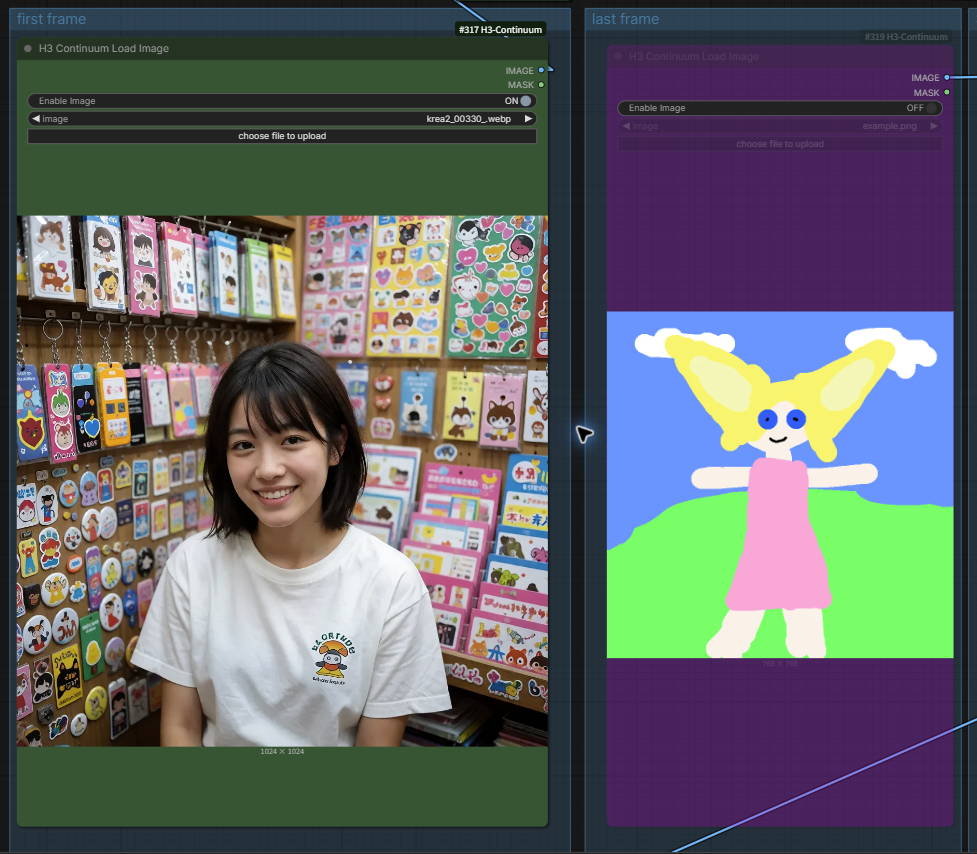
- **First Image** establishes the opening image and is the normal visual starting point for I2VA/FL2VA. It is also the only media input that can drive `Size Source = First Image`.
- **Last Image** constrains the sequence ending. Leave it `OFF` for T2VA and ordinary I2VA. With a connected Last Image, extending or regenerating the sequence may rebuild the terminal pair.
- **Reference Images 1–9** guide identity or appearance throughout generation. Inputs 1–3 remain on the Sampler; optional inputs 4–9 are on `H3 Continuum Reference Images`, connected to the Sampler's `Reference Images (Optional)` socket. The helper only bundles images: resizing, hashing, and VAE encoding remain in the existing Sampler path. Empty slots are skipped; Picture numbers follow active slot order after any First/Last Image. Existing three-loader templates still work unchanged.
Saved workflows with the earlier direct image 4/5 inputs migrate those links into a bundle after graph loading. Migration preserves the original source links and only removes a legacy input after its new link is verified. If a source is unavailable or its destination is occupied, the legacy link is retained with a warning. Old API prompts remain accepted; supplying both legacy and bundle images for the same slot is an explicit input conflict.
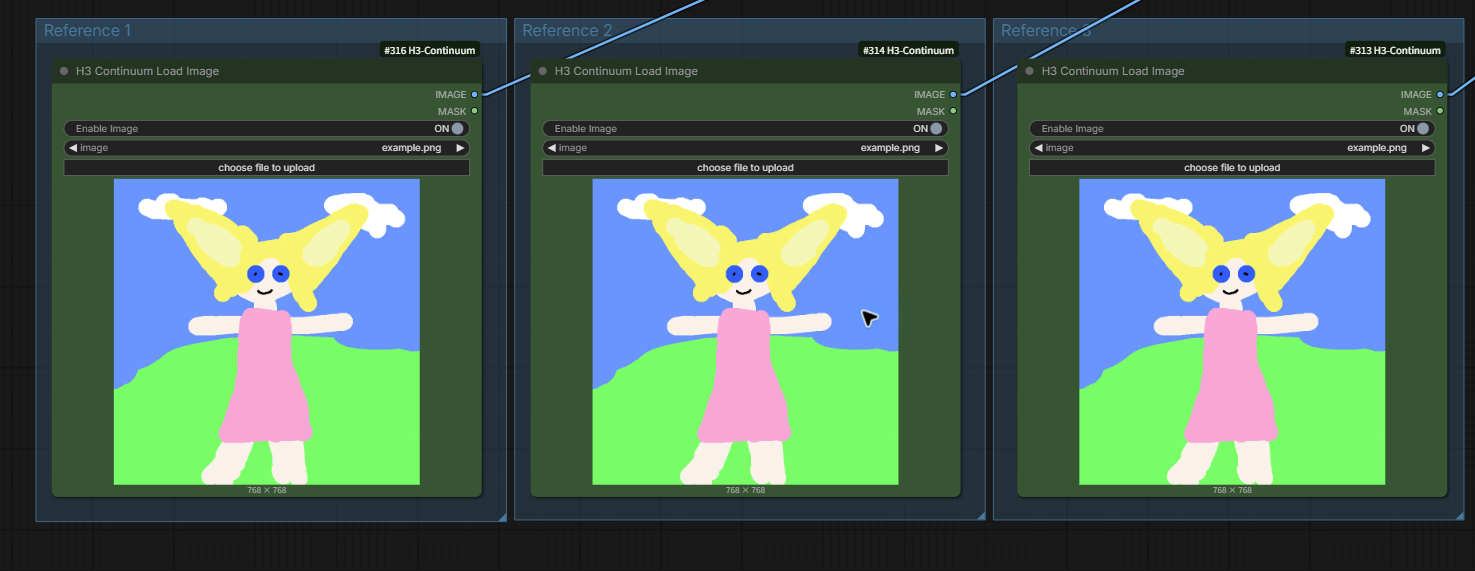
Every `H3 Continuum Load Image` has `Enable Image`. `ON` loads through ComfyUI Core. `OFF` uses native node bypass and makes that optional path behave as unconnected without deleting the node or cable. First, Last, and up to nine Reference Image inputs can therefore be connected without forcing every input to be active. An empty image bundle returns no reference and does not change the zero-to-three-image sampling/reuse contract.
| Public loader | Controls | Outputs |
|---|---|---|
| `H3 Continuum Load Image` | `Enable Image`, `image` file | `IMAGE`, `MASK` |
| `H3 Continuum Load Audio` | `Enable Audio`, `audio` file | `AUDIO` |
| `H3 Continuum Load Video` | `Enable Video`, `Video` file, `Force Rate` | `images`, `audio` |
#### Video, audio, and their bypass switches
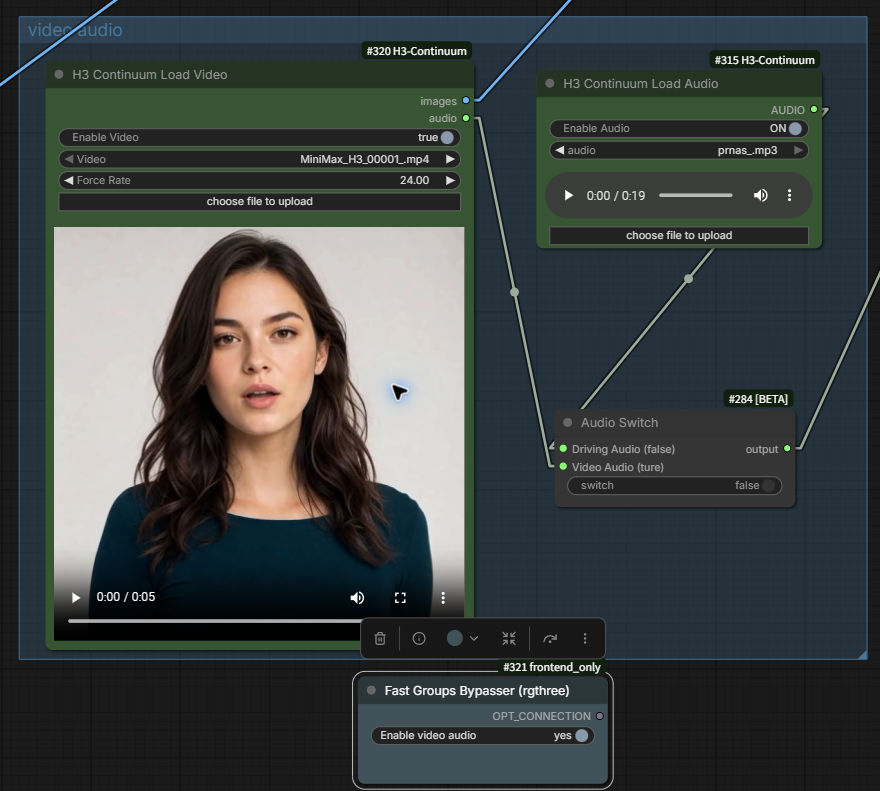
- `H3 Continuum Load Video`: `Enable Video`, `Video`, and `Force Rate`. `Force Rate = 0` uses source FPS; a positive value drops/duplicates frames to that rate while preserving nominal duration and audio. Connect `images` to `Video Guide Frames` when visual video guidance is wanted. Connect `audio` to `Driving Audio` only when the source audio should guide and become the final output.
- `H3 Continuum Load Audio`: `Enable Audio` and the audio file. Use it for Driving Audio or Reference Audio according to the socket you connect.
- The node titled `Audio Switch` in the example image is ComfyUI Core's `If/Else Switch` (`ComfySwitchNode`); `Fast Groups Bypasser (rgthree)` belongs to the rgthree extension. Neither is a Continuum node or a requirement of Continuum. The Continuum loaders already provide their own native ON/OFF controls.
`Audio Continuity` is different from both audio inputs: it passes the previously generated audio context into the next generated chunk. It does not import a source track. Driving Audio replaces final generated audio; Reference Audio only conditions generation.
### Main Sampler controls
| Displayed control | Meaning | Recommended starting point |
|---|---|---|
| `Prompt Format` | `Auto`, `Fixed`, `List`, or `Timeline` interpretation of `Sequence Prompt` | `Auto` unless you need to force one parser |
| `Continuity` | Prior Video context retained at each chunk boundary | `Balanced — 22 frames` for Standard audiovisual continuation |
| `Base Seed` | Base for deterministic per-chunk seed derivation | Keep the value unchanged when continuing, comparing, or selecting Takes |
| `Control After Generate` | What ComfyUI does to `Base Seed` after a Queue | `fixed` for `Review Each Chunk`, resume, and controlled comparisons |
| `Audio Continuity` | Carries generated-audio context across boundaries | `true` for normal audiovisual generation |
| `Chunks` | Planned total chunk count, from 1 to 16 | Enter the final total, not the number to add next |
| `Seconds per Chunk` | Duration shared by every chunk | 5–15 seconds is the validated range; see duration notes below |
| `Total Length` | Read-only `Chunks × Seconds per Chunk` | Check only; it never edits either input |
| `Size Source` | `First Image` or `Manual` output geometry | First Image for I2VA/FL2VA; Manual for T2VA or exact dimensions |
| `Resolution` | First-Image sizing preset | `Draft — 0.30 MP` for tests, `Balanced — 0.60 MP` for more detail, or `Native 768` for the H3-native short edge |
| `Custom MP` | Custom First-Image pixel budget | Visible only when `Resolution = Custom` |
| `Width` / `Height` | Exact output canvas in 32-pixel steps | Visible/editable only in Manual mode; 32–16384 is accepted |
| `Run` | `Generate Full Video` or `Review Each Chunk` | Use Review when you want a human decision after each physical group |
| `Progress` | Saved raw chunks, safe resume, and Take history | Review turns it On automatically; enable it for resume/regeneration |
| `Ready to Queue` | Plain-language summary of the next Queue | Read it before pressing ComfyUI's top-right blue `Run` button |
| `Show Advanced Settings` / `Hide Advanced Settings` | Shows or hides technical controls | Visibility only; it does not change their values |
`Continuity = Balanced — 22 frames` with `Continuation Backend = Standard` and `Audio Continuity = true` uses the current Masked AV route. `Fast — 5 frames`, `Strong — 39 frames (Experimental)`, and `Auto — conservative` safely resolve to the older Reference Context route while generated-audio continuity is on. With Audio Continuity off, Standard uses the Video-only masked route.
#### Choose First Image sizing or Manual sizing
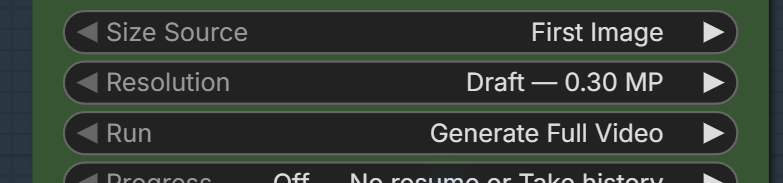
`Size Source = First Image` preserves the connected First Image aspect ratio. `Resolution` then chooses its pixel area:
| Preset | Target |
|---|---|
| `Draft — 0.30 MP` | Fastest and lowest-memory First Image starting point |
| `Balanced — 0.60 MP` | More detail with greater memory and processing cost |
| `Native 768` | 768 px short-edge target with a 1344 px long-edge cap |
| `Custom` | `Custom MP` selected by the user; separate from the Native 768 cap |

`Size Source = Manual` ignores the preset and uses exact Width/Height values. Both must be multiples of 32. Manual is the normal choice for T2VA and also supports a 32×32 diagnostic canvas when only generated audio is being checked.
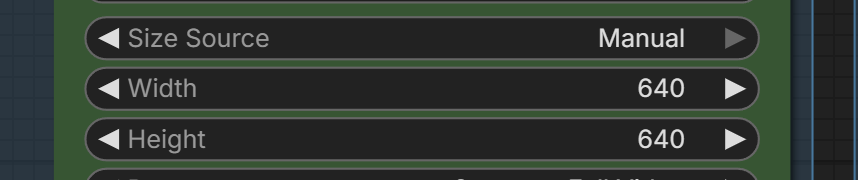
If First Image mode is selected but no usable First Image reaches the Sampler, V3.8 uses the stored Manual Width/Height as a safe fallback and reports the dimensions in `status`. Select `Size Source = Manual` to inspect or edit those values; Width/Height are hidden in the First Image facade. Reference Images and Video Guide never become implicit size sources. The historical `Auto / Landscape / Portrait / Square` values are migration/API compatibility values, not current Main choices.
Size selection is built into the V3.8 Sampler. A separate megapixel, empty-latent, or image-size node is not required for the normal Continuum workflow.
#### Choose a chunk duration
- **5 seconds** is a valid H3 duration and the fastest practical choice for workflow checks, Review UI checks, and quick Takes.
- **8–10 seconds** usually reduces the number of handoffs while keeping each Queue easier to review and rerun.
- **15 seconds** is the [upstream MiniMax H3 native maximum per generation](https://github.com/MiniMax-AI/cli/blob/main/skill/h3-video/SKILL.md) and minimizes the number of boundaries, but it increases per-chunk time and memory. Longer is not automatically higher quality.
- Continuum accepts 4–30 seconds for compatibility and experimentation. Values above 15 seconds are not the same as an upstream native-duration recommendation and can be expensive at high resolution.
For an audio-only listening diagnostic, use T2VA, `Size Source = Manual`, and a very small canvas such as 32×32, then play the saved video and ignore its picture. This is useful for hearing music or boundary continuity; it is not evidence of normal-resolution video quality.
### Advanced Sampler controls
| Control | When it appears | Meaning |
|---|---|---|
| `Continuation Backend` | Advanced open | `Standard` is the V3.8 path; `Compatibility` restores the older Reference Context route for comparison |
| `Regenerate From` | Advanced open and Progress On | `Auto` resumes the longest compatible prefix; `Chunk N` reuses earlier chunks and rebuilds N through the target |
| `Variation Nonce` | Explicit `Regenerate From = Chunk N` | `0`: automatic variation selection with interrupted-run resume; `1` or higher: a fixed variation value. Base Seed and the other generation settings stay unchanged |
| `Run Name (Optional Override)` | Advanced open and Progress On | Stable name for resume and Render History; blank uses the Sampler's automatic identity |
| `Reference Image Size` | Advanced open and a Reference Image connected | `Match Output` is practical; `Max Identity` preserves more reference detail and may use more memory |
| `Video Guide Size` | Advanced open and Video Guide connected | `Efficient — 0.4 MP`, `Balanced — 0.6 MP`, or `Match Output` |
Frontend-managed IDs, selected Take IDs, one-shot review actions, diagnostics, preview, and legacy compatibility values are deliberately not editable as ordinary node widgets. The corresponding settings or action buttons below are the supported interface.
### Review-state controls
When `Run = Review Each Chunk`, `Progress` is On, and a review unit is ready, the settings view changes to this action view:
| Button | What the next top-right ComfyUI `Run` does |
|---|---|
| `Use it and continue` | Accepts the current result, reuses it, and generates one next physical group |
| `Try this chunk again` | Keeps the earlier accepted prefix and creates another Take of the current review unit |
| `Start again from Chunk 1` | Selects a fresh branch from Chunk 1 with current settings and automatic variation; press Queue afterward. Saved Takes are kept. The selection resets to Auto after Queue |
| `Use it and finish the rest` | Accepts the current result and generates every remaining group without further review pauses |
| `Back to Settings` | Shows the normal settings; does not queue, reset, or discard the review |
| `Return to Review` | Returns from settings to the pending review; does not undo edited values |
| `Render History — N Takes` | Opens or closes stored Take browsing; N is Take count, not chunk count |
| `Previous Take` / `Next Take` | Changes the selected stored Take only |
| `Use This Take` | Makes the selected Take canonical on the next Queue; no new sampling is required |
| `Continue From Here` | Branches from the selected Take and generates the next review unit |
The action button selects intent and gains a `✓`; it does not start generation. Press ComfyUI's top-right blue `Run` button afterward. Full step-by-step examples begin in [Review, continue, and revise a chunked video](#review-continue-and-revise-a-chunked-video).
### H3 Continuum Reference Audios
`H3 Continuum Reference Audios` bundles up to three standalone audio references behind one `Audio References (Optional)` Sampler socket. Connect the references without gaps and use `